EL
 EN
4th Greek Online Gaming Day: Market growth, the fight against illegal gambling, and safeguarding sports integrity
The 4th Greek Online Gaming Day, held at the five-star Grand Hyatt Hotel, concluded with great success. The conference highlighted the key challenges, opportunities, and strategies expected to shape the future of online betting and gaming—both in Greece and internationally—while also addressing the serious issue of illegal gambling.
The event was organized by the Hellenic Gaming Association (HGA)—whose full members include Novibet, Winmasters, NetBet, Fonbet, and Interwetten—in collaboration with CLEON Conferences & Communications, and featured prominent speakers.
Attendees included representatives from the government, regulatory authorities, licensed operators, technology firms, legal and consulting companies, and financial institutions, as well as top executives and industry experts.
In his opening address and presentation of the event's themes, HGA President Christos Panagopoulos emphasized, among other points: "Online gaming is not a means to get rich quick or a source of addiction, but a form of entertainment. That is how we must view and approach it. The sector has expanded significantly in recent years, becoming a highly active part of the country's economy." The sector has been growing for many years, with prospects for further expansion in the years ahead. It is an industry that generates significant revenue—both for the state and for investors—driven by high turnover. Companies in the sector employ a vast workforce, both in Greece and abroad. Operating at the cutting edge of technology as online platforms, they offer competitive remuneration and contribute to economic growth.
"Our sector is not a secondary matter. As gaming companies, we generate significant turnover and must pay taxes to the state—especially at a time when every euro is invaluable. We face a heavy tax burden, and we want our voices heard—not to seek tax cuts, but to balance other aspects of the industry and protect it from illegal betting. Illegal gambling is massive; previous studies indicate a turnover of around €2 billion that goes untaxed and is siphoned off from the legitimate market."
In his remarks, the General Secretary of Sports, Giorgos Mavrotas, stated: "Illegal betting poses a significant threat. It harms the state through lost tax revenue, damages legal betting companies due to unfair competition, and hurts the players themselves. Essentially, it fuels match-fixing.
Match-fixing is closely linked to illegal betting. While transactions with legal companies can be traced, illegal operations operate in total obscurity, making investigations impossible. It is a borderless, international problem that requires international cooperation." Addressing these threats is... a team sport, and you need teammates with whom you must build trust.
As for the taxation of winnings, a portion goes toward sports. In previous years, it stood at 66 million, whereas now it is at 80 million. We can see the results in the progress being made in sports, both at the club level and within our national teams."
The event was moderated by lawyer and journalist Antonis Papagiannidis. It opened with introductory speeches by Dimitris Markopoulos, Deputy Minister of National Economy and Finance (responsible for Tax Policy); Giorgos Pitsilis, Governor of the Independent Authority for Public Revenue; Antonis Vartholomaios, Chairman of the Hellenic Gaming Commission; and Panagiotis Trisokkas, Chairman of the National Betting Authority of Cyprus.
In his speech, Mr. Markopoulos noted: "The online gaming market is one of the fastest-growing sectors of the global digital economy. It is not merely entertainment but a complex ecosystem. In recent years, the market has shifted toward a fully interconnected environment. It follows the norms of digital collective evolution." "Just as society as a whole is going digital, our government has also made significant digital strides. Technological advancements in this field are impressive, and further convergence with virtual reality is expected in the future. You face major challenges: protecting players' personal data, combating hacking and cheating, and—in my opinion, the most important aspect—protecting minors."
The Minister also referred to the recently passed legislation, explaining some of its provisions, and emphasized that he remains "open" to consultation with the industry so that necessary synergies can be created wherever needed to ensure the market adapts even more effectively.
For his part, Mr. Pitsilis stated: "The issue of player protection is becoming increasingly important. The sector is evolving rapidly in terms of technology, and such evolution makes the legislative process more challenging. It is crucial to have rules that ensure fair taxation and provide us with the necessary tools for oversight. The newly passed provision aligns with international frameworks while establishing a very specific regulatory structure. The volume of funds involved is immense, and we must ensure that we are ready to intervene should any attempt at money laundering occur." "As for myDATA, it became a decisive factor in reducing VAT in the country and added credibility to the national economy."
Subsequently, Mr. Vartholomaios conveyed the HGA’s views on the market and the recent bill regarding the gaming sector. "In 2025, approximately 900,000 citizens—10.55% of our population—engaged in illegal gaming activities. The estimated turnover approaches €2 billion, representing a loss of €400 million for the Greek state. The new regulatory framework marks a significant step in this direction, strengthening the role of the Hellenic Gaming Commission (HGC), which is being upgraded into a more robust and modern supervisory body.
One of the most important changes is the shift from a model of passive reaction to one of active prevention and early intervention. Technology is constantly evolving, and illegal activities quickly adapt to new conditions. For this reason, continuous cooperation among authorities, operators, and all stakeholders is essential.
A major issue is the illegal promotion of unlicensed operators via the internet and social media. The HGC has identified instances of influencers advertising illegal platforms and has taken the necessary action with the competent authorities. A few days ago, legal action was brought against 18 influencers who had promoted illegal betting companies. Five of them have a combined following of more than three million people, many of whom are minors. The Authority aims to address these practices responsibly, protecting society and creating a safer environment for citizens. The new European regulations establish a common framework of rules, strengthen cooperation between countries and set stricter requirements for regulated entities."
HGA Deputy Director General Antonios Alexiou presented a review of the online betting industry in 2025 (see the attached tables). Referring to the Greek market, he noted its positive performance, with substantial revenue growth and strong expansion of the online channel, particularly online casino gaming. He also stressed that major casino investment projects are expected to further strengthen the market and create new growth opportunities.
He placed particular emphasis on the need to tackle illegal betting, pointing out that market development should be assessed not only by financial figures but also by whether it takes place within a safe and lawful framework. Combating illegal gambling, he said, is one of the main priorities for the period ahead. He also referred to the increasing use of digital channels and influencers by illegal platforms, stressing the need to adapt oversight tools to the new digital environment.
The key figures presented reflected both the momentum and the challenges of the online gaming market. The Greek market is growing significantly, with public revenue approaching €1.2 billion. The gambling market recorded growth of around 52%, while online betting remains the main driver of expansion, with a growth rate of approximately 12%. Online casino gaming was particularly strong, increasing by about 19% and confirming the shift in consumer habits towards digital platforms. Figures for the first quarter of 2026 also showed market growth of around 18% compared with the same period in 2025.
According to the survey findings presented, around one in two adults has participated in gambling. The 18–24 age group has the highest participation rate, at approximately 58%. Most players report spending up to around €40 per session, while a smaller but significant proportion, approximately 9%, report monthly spending above €300.
Particular attention was given to illegal betting: an estimated 10% of the public has used illegal platforms. The number of these users is estimated at approximately 1.8 million, with average estimated spending close to €2,000. Meanwhile, the blacklist of illegal websites contains more than 14,500 sites, illustrating the scale of the challenge for regulators.
As part of efforts to strengthen supervision, it was also reported that fines totalling approximately €1.7 million have been imposed for infringements involving illegal activity and promotion.
The first panel of the day then addressed economic and tax issues in online betting. Speakers included Nikolaos Dimitrakopoulos, a partner at Deloitte, one of the leading multinational professional services firms; lawyer and former Deputy Minister of Sports Giorgos Vasileiadis; and Novibet Tax Director Ioannis Kyrifidis.
Lefteris Anastasakis, Vice President of the Board of consulting firm PRIORITY, presented research on illegal betting and participated in the second panel, “Illegal Betting: Current Situation, Analysis and Future Prospects”. He was joined by Eurobank Head of Fraud Detection Christos Barkas; OCM Digital Media Co-Founder and CEO Galinos Giaglis; General Secretary of Sports Giorgos Mavrotas; and HGA representative Tasos Vassios.
“To give an indication of the scale,” Mr Anastasakis said, “the legal market in Greece generates revenue of approximately €1.2 billion. The key point is that illegal gambling is estimated to represent around 50% of the legal market. For comparison, the total gambling market in Cyprus operates at similar levels, demonstrating the scale of the challenge facing Greece.
“Tackling illegal gambling is not only about protecting the market and public revenue. There is a very important social dimension, primarily concerning the protection of players and particularly vulnerable groups.
“One of the most worrying findings is the connection between illegal betting and addiction. Easy access through digital channels can expose users to unregulated platforms without the safeguards applied in the legal market.
“Gambling addiction is an extremely serious phenomenon, affecting not only the player but also their family and social environment,” Mr Anastasakis noted.
Building on his opening remarks, the General Secretary of Sports added: “The Macolin Convention is an important international instrument for protecting the integrity of sport and combating the manipulation of sports competitions. This phenomenon cannot be addressed solely at national level, as illegal betting and related practices are now international and require coordinated action, cooperation and information sharing among all stakeholders.
“The Convention promotes the prevention, detection and combating of match-fixing, with an emphasis on cooperation between public authorities, sports organisations, regulators, law enforcement agencies and betting service providers.
“At the same time, the Convention places particular emphasis on combating illegal betting, providing for measures such as restricting illegal online activity, addressing illicit financial flows, combating illegal advertising and improving consumer awareness.
“Effective implementation of the principles of the Macolin Convention is essential to ensuring a safe and trustworthy sports and betting environment, protecting athletes and fans as well as the credibility of sport itself.”
Paidby SVP Sales and Relationship Management Isabella Frangou spoke about the new payments landscape in gaming before handing over to the third panel, which explored gaming’s contribution to the media and sport. Speakers included Online Publishers Association President Theocharis Filippopoulos; Stathis Georgopoulos, Head of the Legal Department of the Association of Private National Television Stations (EITISEE); and Marialena Kotoula, Affiliate Partnerships Manager at digital sports media group Better Collective.
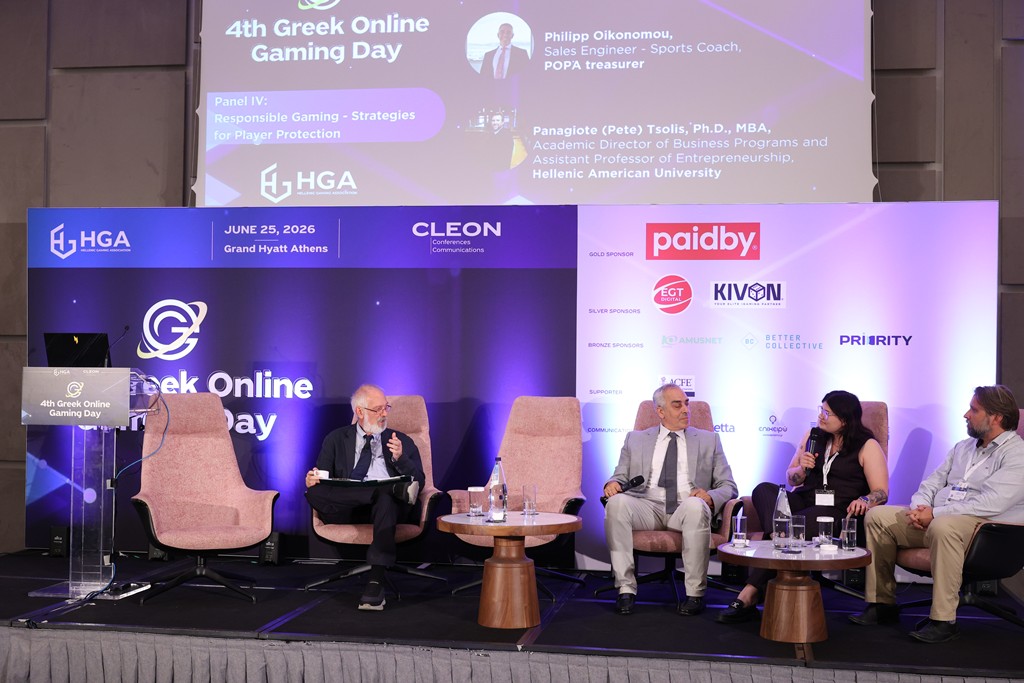
The fourth and final panel focused on responsible gaming and strategies to protect players. Participants were Interwetten Teamlead Legal Processes and Group DPO Viktoria Müllner; Sales Engineer and Sports Coach Filippos Oikonomou; and Dr Pete Tsolis, Academic Director of Business Programs and Assistant Professor of Entrepreneurship at Hellenic American University.